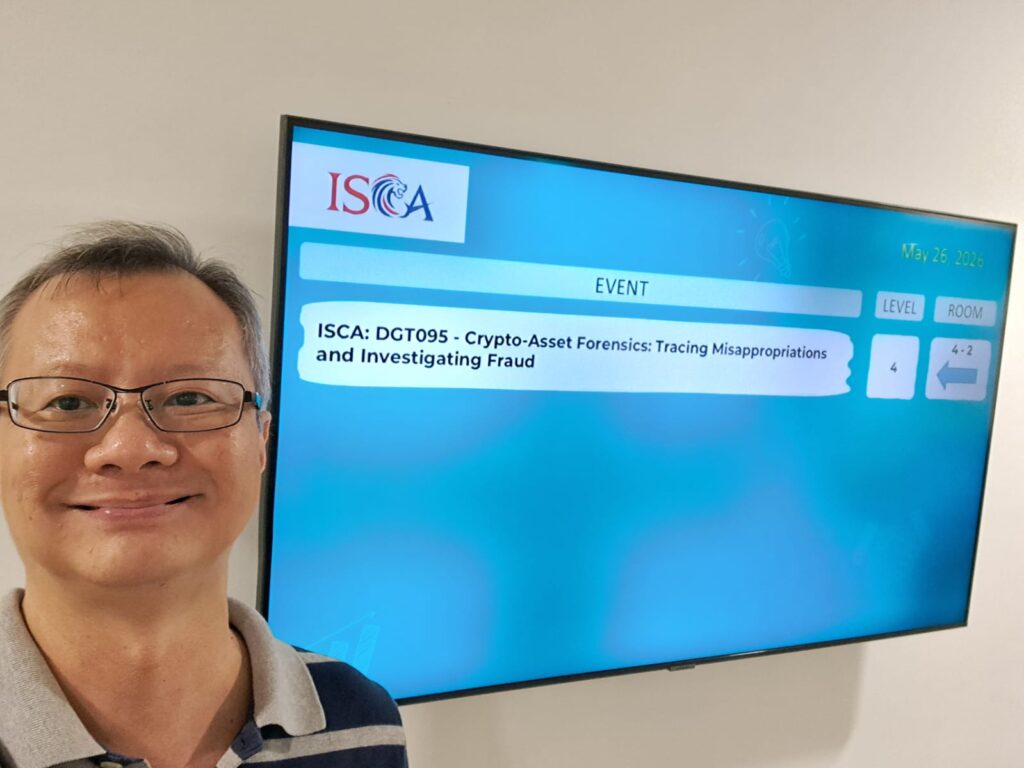
I recently completed a course on Crypto-Asset Forensics and Blockchain Transaction Tracing at ISCA Academy (DGT095).
The program covered a comprehensive range of topics across five modules:
Foundations — Blockchain fundamentals, crypto-asset types (tokens, coins, stablecoins), and how transactions are verified on-chain.
Blockchain Tracing — Techniques for tracing transactions, identifying related parties, understanding crypto mixers, and navigating legal frameworks for information requests to service providers and exchanges.
Advanced Attribution — DeFi, smart contracts, cross-chain tracing, proving common ownership, and the emerging role of AI in blockchain forensics.
Real-World Case Studies — Including tracing misappropriated stablecoins in a VC-startup fraud scenario, and examining how a crypto exchange manufactured $1.4 billion worth of stablecoins out of thin air.
Professional Ethics & Compliance — Applying the Five Fundamental Principles (EP100) to crypto forensic engagements, alongside AML/CFT obligations under EP200 covering risk-based approaches, suspicious transaction reporting, and documentation requirements.
I had always had an interest in crypto but never really delved more into it until today’s class. Realized that it is an interesting world because there are many positive and negative use-cases with the use of blockchain technologies into the business and fraud space.
Glad to have take the full day to enrol and open up more avenues for further study into the world of crypto and its applications.
No responses yet