15 May 2026
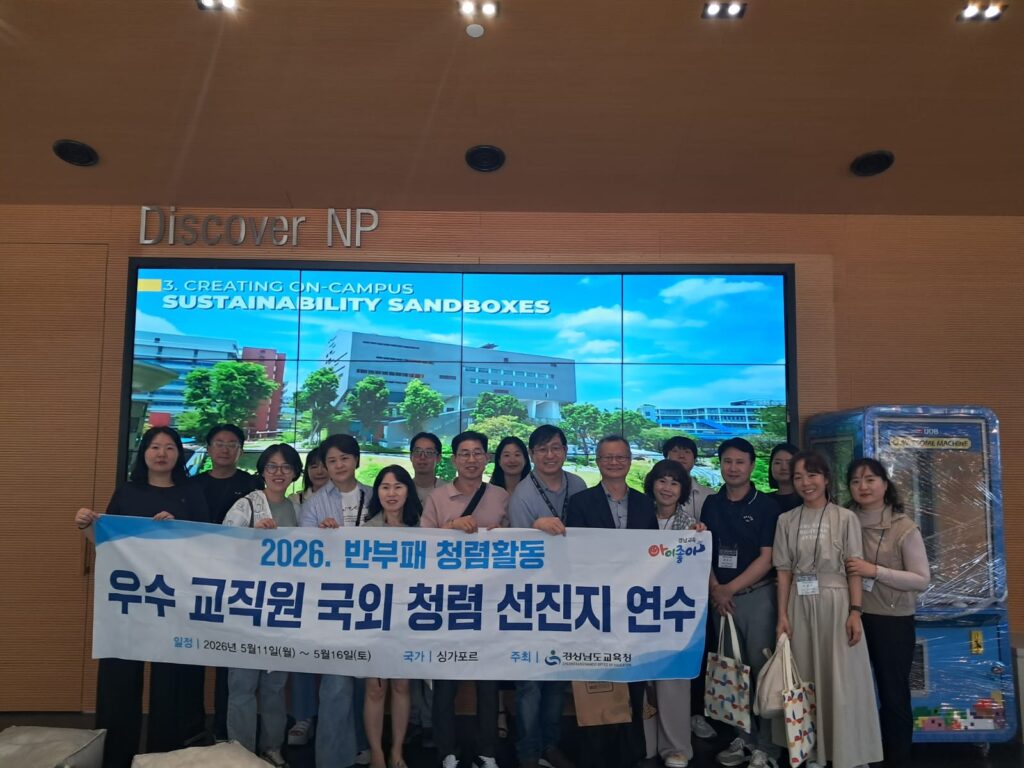
Today I had the privilege of hosting a delegation of 16 government audit officials from the Gyeongsangnam-do Office of Education (경상남도교육청) here in Singapore at Ngee Ann Polytechnic — an institution I served for many years as Head of Internal Audit.
The delegation, comprising officials from the Audit Division and affiliated oversight institutions, are on a study visit to Singapore to examine our public sector governance frameworks, anti-corruption practices, and internal audit systems. That they chose to include a session with the ACFE Singapore Chapter was both an honour and a reflection of how seriously the Korean public sector takes the fight against fraud.
Our sharing covered five areas I am deeply passionate about:
🔍 The Fraud Landscape — Education institutions globally rank among the
top 5 most-victimised sectors. This is not a theoretical risk. Singapore’s own Auditor-General’s Office (AGO) has reported audit lapses across many educational institutions over 18 years.
🏛️ Singapore’s Governance Architecture — From the AGO and CPIB at the apex, to Audit Committees with real independence at the institution level. Our model works because it has teeth — and because findings are made public.
📋 Real Audit Cases — We walked through actual AGO-reported findings: procurement irregularities, IT privileged access gaps, hidden subsidies to related parties, and payment file security failures. Case-based learning cuts through theory in a way no textbook can.
🛡️ Three Lines of Defence — And critically, the specific controls that directly address gaps the AGO has identified repeatedly — privileged user monitoring, encrypted payment transfers, arm’s-length related-party pricing, and mandatory competitive quotation.
📣 Integrity Culture & Whistleblowing — 43% of frauds globally are detected through tips. Building safe, anonymous reporting channels and genuinely protecting reporters is not optional — it is the single most effective fraud detection investment any organisation can make.
The key message I left with the delegation: Singapore’s lessons are meant to be adapted, not simply adopted. The principles — independence, transparency, risk-based audit, and zero tolerance for corruption — are universal. How they are embedded must fit the local context.
It was an afternoon of rich exchange, sharp questions, and genuine cross-border learning. I am grateful to the Gyeongsangnam-do Office of Education for making this visit part of their study programme, and I hope the insights carry forward into stronger audit capacity and integrity governance for the 400,000+ students and 30,000 educators they serve.
감사합니다 — Thank you! 🙏
No responses yet